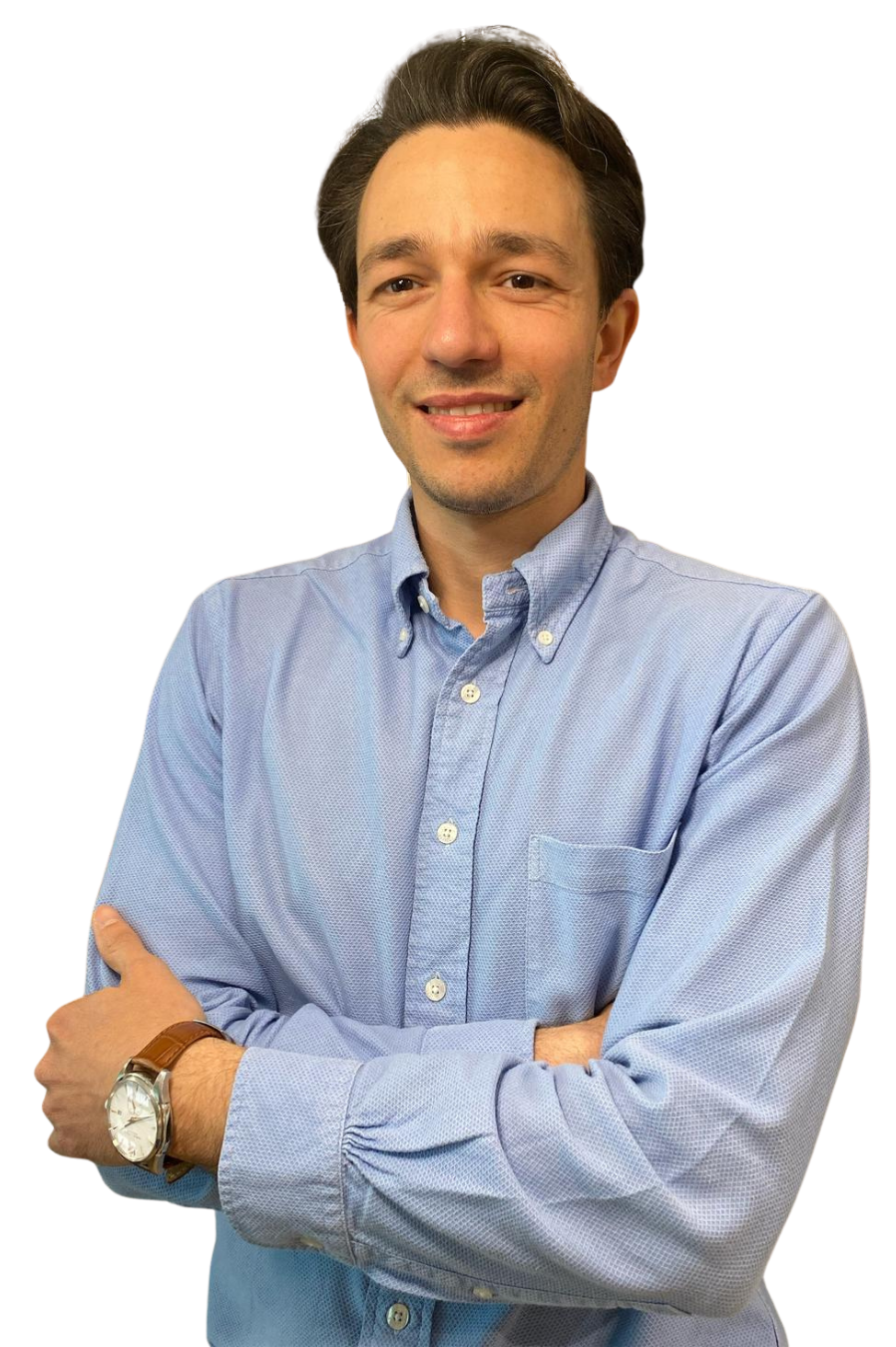
Name: Riccardo Brusori
Year of Birth: 1992
Place of Birth: Bologna, Italy
Current Residence: Germany
Languages:
Italian, English, Spanish, German
Education:
International Relations, Business Administration
Current Role:
Key Account Manager – Optical Metrology
Name: Riccardo Brusori
Year of Birth: 1992
Place of Birth: Bologna, Italy
Current Residence: Germany
Languages:
Italian, English, Spanish, German
Education:
International Relations, Business Administration
Current Role:
Key Account Manager – Optical Metrology
When we reflect on who we are and how we got there, we often overlook certain experiences that, when we step back and see the full picture, turn out to have shaped us most profoundly. They are like “secret ingredients” — the ones that give a recipe its distinctive taste. In this session, I want to shine a light on them and what they meant for me.
When I was 16, I spent a month in Africa as part of a mission run by a local church in Bologna. The aim was to provide humanitarian aid and support specific development projects in the Iringa area of Tanzania. I was very young, but the smiles and gratitude I found there will always remain in my heart.
Back home, that same impulse drew me toward volunteering with people with disabilities. It started during summer programs with Anffas, an NGO supported by my high school in Bologna. After joining a two-week summer camp with a group of disabled people, I continued volunteering regularly through my final year of high school and into my university years. In my last year of my Master’s, I was selected to tutor students with disabilities for a full academic year.
These experiences taught me how many things we take for granted in our society can become major obstacles for others. Crossing a street, taking a bus, reading a book. Try doing any of them from a wheel chair or when you are not able to hear or see properly. Accessibility is a right which we too easily forget to defend — perhaps because it seems to affect only a handful of people. But that handful deserves better.
I cannot imagine who I would be without my eight years of basketball coaching. After tearing my cruciate ligament and meniscus for the second time in a single year, I gave up playing and started coaching children at 18. Within a couple of years I had moved from assistant coach to coordinating the entire basketball sector for players aged 6 to 12 — 3 teams to train directly, 9 to oversee, a staff of around 12 coaches, and roughly 270 children spread across 6 or 7 gyms. I was also responsible for recruiting both kids and prospective coaches. At 20 years old, this was as close to a real managerial experience as I could have gotten without knowing it. And I did that besides my studies for 3 years. From 23 to 25 I reduced my commitment, focusing on youth teams across three clubs — Castiglione Murri, Salus Pallacanestro Bologna, and Grifo Basket Imola. During my last year in Italy I also coordinated all activities and tournaments for the Italian Basketball Federation in the Province of Bologna. The passion even followed me to the Netherlands, where during my second university year I joined a basketball academy, RTC Noord, coaching Dutch youths twice a week.
Basketball coaching allowed me to create a strong network and to better understand how to deal with young people. Beyond the organizational skills, coaching taught me two principles I carry into everything I do: be firm, but stay open and willing to listen — and lead by example. When you work with young people, you are an educator first and a coach second.
I am a deeply curious person and an avid reader. Over the years I have built knowledge in fields that are sometimes entirely unrelated to one another, driven purely by curiosity: drug policy (the topic of my first Master’s thesis), urban planning, public transportation, aviation, productivity and learning, emerging markets, Colombian politics, geopolitics, geoeconomics, and the intersection of new technologies with global politics — particularly AI and semiconductors.
I try to read at least an hour of news every day and one book per month. My daily reading includes four newsletters — two from the New York Times, “Brussels Playbook” from Politico Europe, and “5 Cosas” from CNN in Spanish — as well as the Italian newspaper Corriere della Sera. I also follow over a dozen weekly and monthly newsletters from thinkers like Parag Khanna, Carlo Ratti, Ayesha Khanna, Paul Krugman, and Ray Dalio, as well as institutions such as the Aspen Institute, Harvard Business Review, Capgemini, EY, Siemens, and Yole Group. I rigorously select my sources based on their reputation and knowledge, and I disregard opinions without solid data to back them up.
Outside of work, I try to maintain a healthy work-life balance through an active lifestyle.